
Updated October 2026
Cabinet water damage repair in Oklahoma City depends on what the boxes are made of. Particleboard and MDF swell and crumble when wet and do not shrink back, while plywood boxes often dry and stay sound. Water also runs under the toe-kick to the floor beneath the cabinets, so that space has to be opened and dried too.
What happens to cabinets when water gets into them
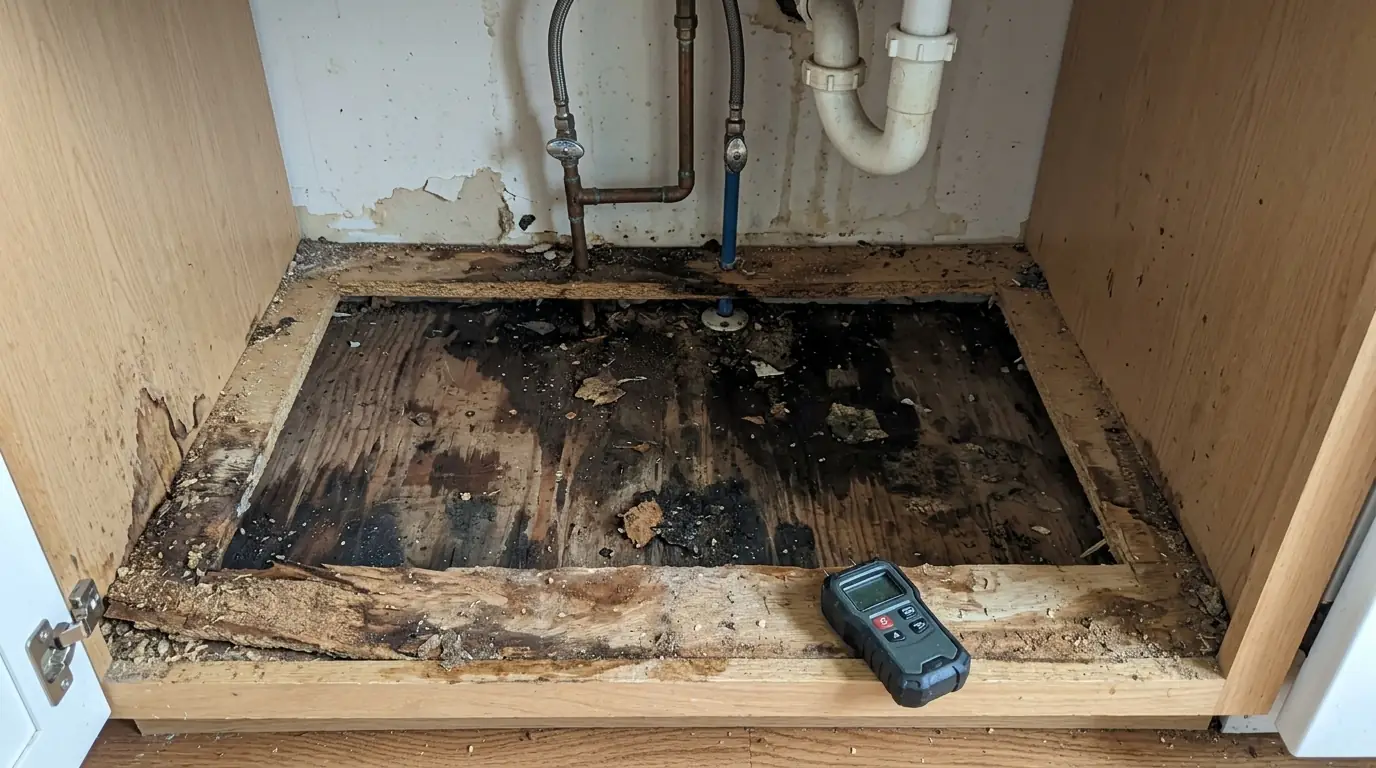
Most cabinet boxes are particleboard or MDF with a laminate or paper face. When water soaks the raw edges, the board swells, the face peels and the material loses its grip on screws and hinges. Plywood boxes and solid wood face frames hold up much better and can usually be dried in place.
The hidden part is underneath. Cabinets sit on a toe-kick base that traps water against the subfloor, and a leak can soak the floor under the whole run while the cabinet interior looks only slightly damp.
We test the boxes and the floor beneath, drill or remove the toe-kick to dry the cavity, and then decide which boxes stay. Swollen sink bases are commonly replaced alone, so the doors and counters on either side can stay.
What decides the price of a cabinet water repair
Cabinet repair costs swing widely, because one box and a whole kitchen run are very different jobs. These factors decide where yours lands.
- Number of boxes affected. Replacing one sink base is a small job. Several boxes along a run means a bigger rebuild.
- Cabinet material. Plywood boxes can often be dried. Particleboard that swelled has to be replaced.
- Countertop type. Laminate lifts easily. Stone and quartz need careful removal and can crack.
- Matching doors and finish. Reusing original doors keeps a match. A finish no longer sold can mean refacing more boxes.
- Floor under the cabinets. Wet or rotted subfloor under the toe-kick adds drying or replacement work.
- Plumbing disconnect and reset. Sinks, disposals and dishwashers must be disconnected and reconnected around the repair.
Repair, replace one box or replace the run
Most cabinet water damage ends in one of these outcomes. The right one depends on the material and how far the water went.
| Option | When it fits | What stays | Main tradeoff |
|---|---|---|---|
| Dry and seal in place | Plywood boxes that got wet briefly | Everything | Only works if the wood never swelled |
| Replace the cabinet floor | Only the bottom panel is swollen | Box, doors and counter | Patch is visible inside the cabinet |
| Replace one box | Sink base or one box failed | Doors, counter and neighbors | Finish match on new box sides |
| Replace the full run | Several boxes swollen or rotted | Usually nothing | Higher cost and longer downtime |
Cabinet repairs fall into three types, from one swollen box to pulling the counters off a whole run.
Swollen Cabinet Boxes
Particleboard that swelled does not return to its size, even after it dries. A box with a swollen floor or side can sometimes get a new bottom panel or a sealed plywood liner, but one whose sides have softened loses its hold on shelves and hinges. In that case we replace the box and reuse your doors and drawer fronts where they survived, which keeps the finish matched.
Sink Base Damage
The sink base takes most of the water in a kitchen or bathroom, from drain slip joints, supply lines, garbage disposals and dishwasher connections. We fix or have the plumbing fixed first, then pull the base floor and check the subfloor under it. Replacement sink bases are built from moisture-resistant plywood where possible, so the next drip does less harm.
Bathroom vanity bases get the same treatment, with extra attention to the floor under the toilet nearby.
Countertop Removal and Reset
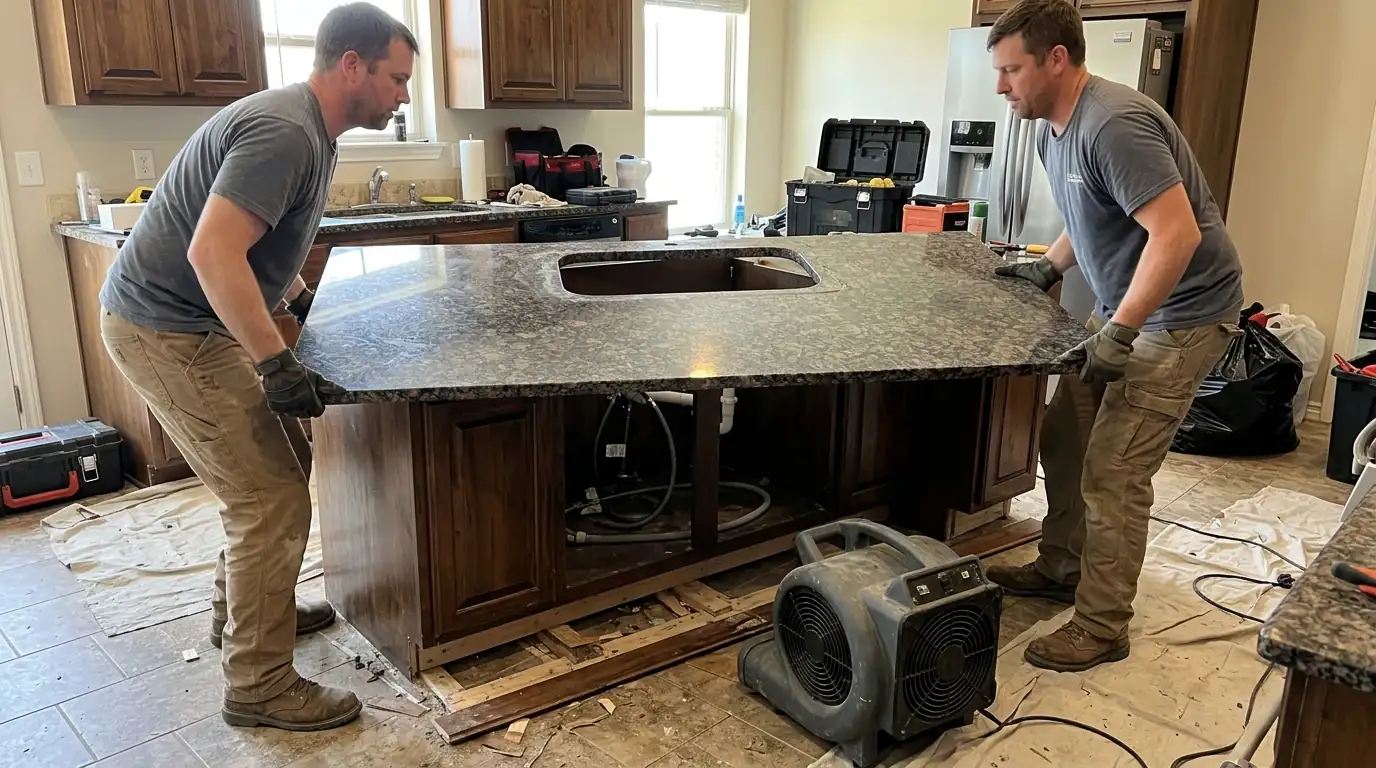
When boxes along a run have to be replaced, the countertop comes off first. Laminate tops usually lift cleanly. Stone and quartz are heavier and must be supported and separated from the backsplash with care to avoid cracking at the sink cutout. We disconnect the sink and cooktop, lift the top, rebuild the boxes and reset the counter on level supports before reconnecting the plumbing.
Why newer kitchens are not safe from slow leaks
Cabinet calls come from houses of every age in Oklahoma City, and newer does not mean protected. Gaillardia grew around an Arthur Hills golf course that opened in the summer of 1998, so many homes there are younger than those in the older parts of the city. A younger kitchen still has supply lines, a dishwasher connection and often particleboard or MDF in its cabinet boxes, and one slow drip under a sink can swell a box and the floor under the toe-kick before anyone opens the doors.
How we repair water-damaged cabinets
- We stop the leakWe find the failed drain joint, supply line or appliance connection and have it repaired first.
- We empty and inspectWe clear the cabinets, photograph the damage and take moisture readings on boxes and floor.
- We open and dry the toe-kickWe remove or vent the toe-kick so air can reach the floor under the cabinets.
- We repair or replace boxesSound boxes get dried and sealed. Swollen ones are replaced, reusing doors where they survived.
- We reset counters and plumbingTops go back level, the sink and appliances reconnect, and we test for leaks.
Signs your cabinets have taken on water
- Swollen cabinet floorThe bottom panel of the sink base bubbles, softens or splits at the edges.
- Peeling laminate or veneerThe face film lifts at the edges of doors and side panels.
- Doors that will not closeSwelling in the box or hinge area pulls the doors out of line.
- Musty smell under the sinkA damp smell when you open the doors often means water sat there for weeks.
- Lifting floor at the toe-kickVinyl or laminate rising along the cabinet base points to water below.
Cabinet water damage questions we hear from homeowners
Usually not. Particleboard swells as the glue binding its fibers lets go, and it stays swollen after drying, with less strength. Small edge swelling on a side panel might be sealed and left, but a swollen cabinet floor or soft sides should be replaced.
Rarely. A single damaged box, most often the sink base, can be cut out and replaced on its own. The challenge is matching the finish, so we reuse your original doors when they are sound and look for the closest match when they are not.
In most cases, yes. Stone is lifted with support along its length, and the thin areas around the sink cutout get the most care. There is always some risk with older or already-cracked stone, and we tell you before lifting if we see weak spots.
If water sat there for more than a day or two, it is worth checking. Mold grows on the back of cabinet panels and the floor under the toe-kick where you cannot see it. We look there whenever we open a damaged sink base.
A single sink base replacement can be done in a few days, though the sink is out during that time. Replacing several boxes and resetting stone tops takes longer, often a week or two, mostly because of cabinet lead times and countertop scheduling.