
Updated October 2026
Kitchen fire damage repair in Oklahoma City usually covers three zones: the cabinets and counters closest to the stove, the range hood and ceiling above it, and the grease film that settled across nearby rooms. Heat-blistered cabinet faces and melted laminate generally get replaced, while sealed surfaces farther away can often be cleaned.
What a kitchen fire leaves behind
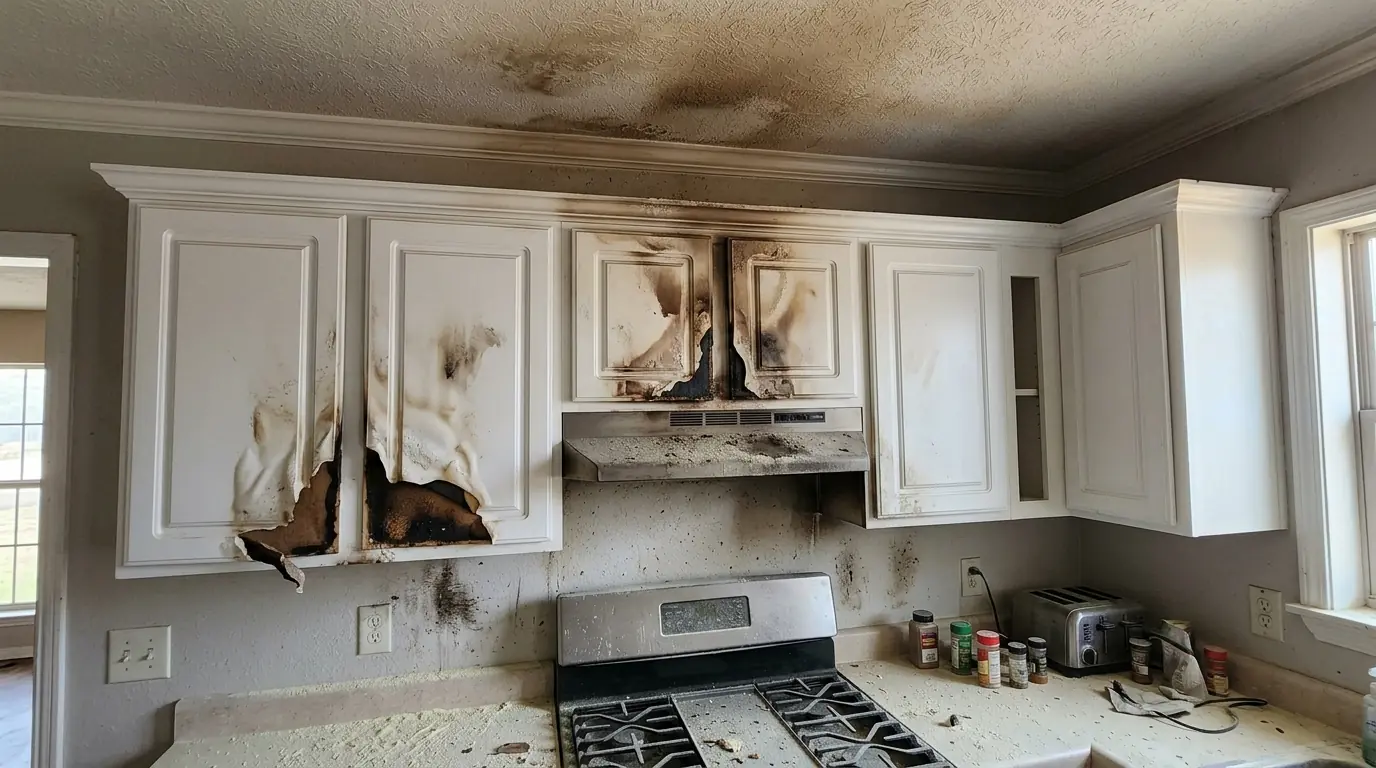
The flames are usually out in minutes. What is left is heat damage near the stove, greasy smoke on every kitchen surface, and dry chemical powder from the extinguisher, which is corrosive and needs to come off soon.
We start with a walk-through and photos, then pull anything that is clearly finished: blistered cabinet doors, melted laminate, scorched drywall. The rest gets degreased and cleaned, top down. Wiring at the range and behind the microwave gets checked before anything is powered back on.
The rebuild follows: new drywall where it was cut out, cabinets replaced or refinished, primer that seals smoke stain, and paint. If the fire got into the ceiling cavity, the work there is closer to full fire damage restoration.
What changes the cost of a kitchen fire repair
Kitchens hold the most expensive finishes per square foot in the house, so these costs swing widely.
- Cabinet material. Solid wood can often be refinished. Thermofoil, laminate and particleboard usually get replaced.
- Countertop type. Laminate near the burner often needs replacing. Stone usually cleans unless heat cracked it.
- Hood and duct. A burned hood or a grease-coated duct run adds parts and labor.
- Ceiling damage. A stained ceiling gets sealed and painted. A charred one gets rebuilt.
- Smoke spread. Grease smoke and extinguisher powder in nearby rooms add cleaning, primer and paint.
Published national price ranges
- $4 to $7 per square foot, or $8,000 to $18,000 on average (per sq ft / per job), fire damage restoration. How Much Does Fire Damage Restoration Cost? (2026) (HomeGuide)
These are planning ranges from national cost guides, not our quote. The price for your house depends on the factors above, and we give you a written scope before repair work starts.
Refinish or replace fire-damaged cabinets?
Cabinets that took smoke but little heat leave you a real choice.
| Option | Works when | Time | Trade-off |
|---|---|---|---|
| Clean and keep | Light smoke film on sealed finishes | Shortest | Odor can linger inside boxes |
| Refinish | Solid wood with stained faces | A few days on site | Every door may change color |
| Replace doors only | Boxes sound, faces damaged | Depends on ordering | Older styles are hard to match |
| Replace cabinets | Warped boxes or peeled laminate | Longest | Highest cost, clean start |
Kitchen fire damage sorts into three parts of the room, each with its own repair decisions.
Cabinets and Countertops
Cabinets beside and above the range take direct heat. Thermofoil and laminate faces bubble and peel, and particleboard boxes warp, so those come out. Solid wood cabinets with only a smoke film can often be degreased, sanded and refinished. Countertops are judged by material: laminate near the burner usually needs replacing, while granite and quartz typically clean up unless the heat cracked them or scorched the sealer near the cooktop edge.
Range Hood and Ceiling
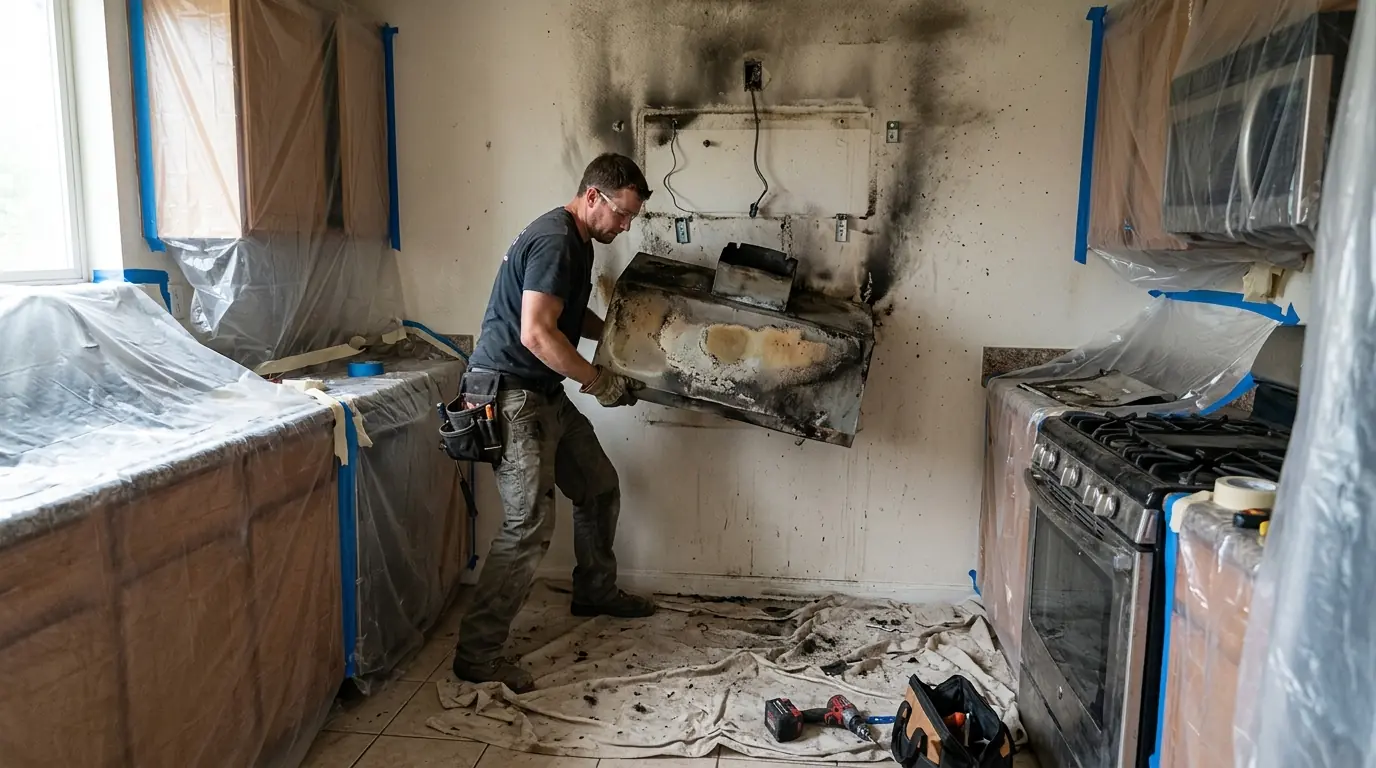
The hood takes the hardest hit and often has to be replaced, along with its duct run if grease burned inside it. The ceiling directly above the stove may be scorched or only stained. We check the drywall for heat damage and the joists above it for charring before deciding whether to clean and seal the ceiling or cut it out and replace it. The hood duct gets traced all the way outside.
HomeGuide puts fire damage restoration at $4 to $7 per square foot, or $8,000 to $18,000 on average, a figure that covers whole-house fires as well as kitchens.
Grease Residue
Cooking fires produce grease and protein smoke, which leaves a sticky, yellowish film that is hard to see but easy to feel. It coats cabinet interiors, walls, the top of the refrigerator and the rooms next to the kitchen. Plain soap mostly smears it around. Degreasing cleaners and several passes take it off, and most of the smell goes with it once the film is gone. Missing the cabinet interiors is the usual reason a kitchen still smells.
Why cooking fires make up so much of this work
The National Fire Protection Association names cooking as the number one cause of home fires and home fire injuries, and unattended cooking as the leading cause of kitchen fires. Because most stovetop fires in Oklahoma City kitchens are out fast, owners tend to underestimate them. A pan fire that lasted two minutes can still leave grease smoke through half the house.
Brands we install on this work
Kitchen rebuilds go back together with USG Sheetrock drywall, Zinsser stain-blocking primers and Sherwin-Williams or Benjamin Moore paint, the materials we install on this work.
Materials we install on rebuilds and roof repairs
From the first walk-through to a working kitchen
- We document the kitchenPhotos and notes on every cabinet, appliance and surface the fire touched.
- We remove what cannot be savedBlistered cabinets, melted counters and scorched drywall come out.
- We degrease and cleanGrease film and extinguisher powder come off every remaining surface.
- We rebuildDrywall, cabinets, counters, the hood and trim go back in, matched to the room.
- We seal, paint and walk itPrimer and paint go on, then you check the finished kitchen with us.
How long you will be without a working kitchen
A small fire limited to the stove area can be cleaned and the kitchen usable again within days, with refinishing after. Once cabinets or counters need replacing, ordering sets the pace, and that can mean weeks without a full kitchen.
Kitchen fire repair questions from Oklahoma City homeowners
Not until the range, the outlets behind it and nearby wiring have been checked. Wipe extinguisher powder off food surfaces, throw out exposed food, and leave the hood fan off if it was in the fire.
Only the ones with heat damage. Peeling thermofoil, bubbled laminate and warped boxes get replaced. Solid wood with only a smoke film can usually be degreased and refinished, which keeps the kitchen matching.
Vacuum the loose powder first, then wipe surfaces with warm water. The powder is mildly corrosive and attracts moisture, so get it off metal, electronics and appliances within a day or two.
Sometimes exactly. If the cabinet line is still made, matching doors can be ordered. If not, refinishing every door to one color usually looks better than mixing old and new faces.
Accidental cooking fires are usually covered under a standard policy, subject to the deductible. You decide whether to file. If you do, we provide the photos and itemized scope your adjuster asks for.