After a tornado, safety comes first: stay out until officials say the area is safe, stay away from downed power lines, leave if you smell gas, and keep out from under sagging ceilings. Then get roof openings and broken windows covered, photograph everything before cleanup starts, and keep a receipt for every temporary repair.
Central Oklahoma knows the season
NWS Norman's Oklahoma tornado statistics from 1950 to present show May as the peak month, with 1,851 tornadoes, an average of 24.4 a year. April follows with 951 and June with 578. Spring is when repair crews are busiest, and when tarps and plywood are hardest to find after a big outbreak.
The metro has seen the worst of it. NWS Norman records that the May 3, 1999 Bridge Creek-Moore tornado, rated F5, destroyed an estimated 1,800 homes and damaged 2,500 more. The May 20, 2013 tornado that struck Newcastle, south Oklahoma City and Moore was rated EF-5 and tracked about 14 miles, and NWS Norman describes the May 31, 2013 El Reno tornado as the widest known tornado on record. In 1999, more homes were damaged than destroyed, and a damaged house with a sound frame can usually be repaired if it is covered quickly.
Safety before anything else
Do not go back into a damaged neighborhood until emergency officials say it is safe. Then look at the house from outside first. A roof that sags, walls that lean, a porch pulling away or cracks that were not there before mean you stay out until someone checks the structure. If you smell gas, leave, keep well away from the house and call the gas company or 911 from a distance. Do not flip lights on or off.
- Stay well away from downed power lines and anything touching them, including fences, puddles and limbs. Treat every line as live.
- Do not walk under a sagging ceiling or a roof section hanging open.
- Wear sturdy shoes, long pants and work gloves. Nails, glass and sheet metal are everywhere.
- Keep children and pets away from debris and out of the house until it is checked.
- If there was a fire, stay out until the fire department releases the property.
- Use flashlights, never candles, in a house that may have a gas leak.
If the house is not safe to stay in, take medications, documents, phone chargers and a change of clothes when you leave, and let your insurer know where you are staying.
Stopping the next rain from doing more damage
The second wave of tornado damage is water. A roof with missing shingles or a hole in the deck lets the next storm into insulation, ceilings and walls, and spring storms here often come in rows. Getting the house dried in, meaning covered and closed, is the most important repair in the first days.
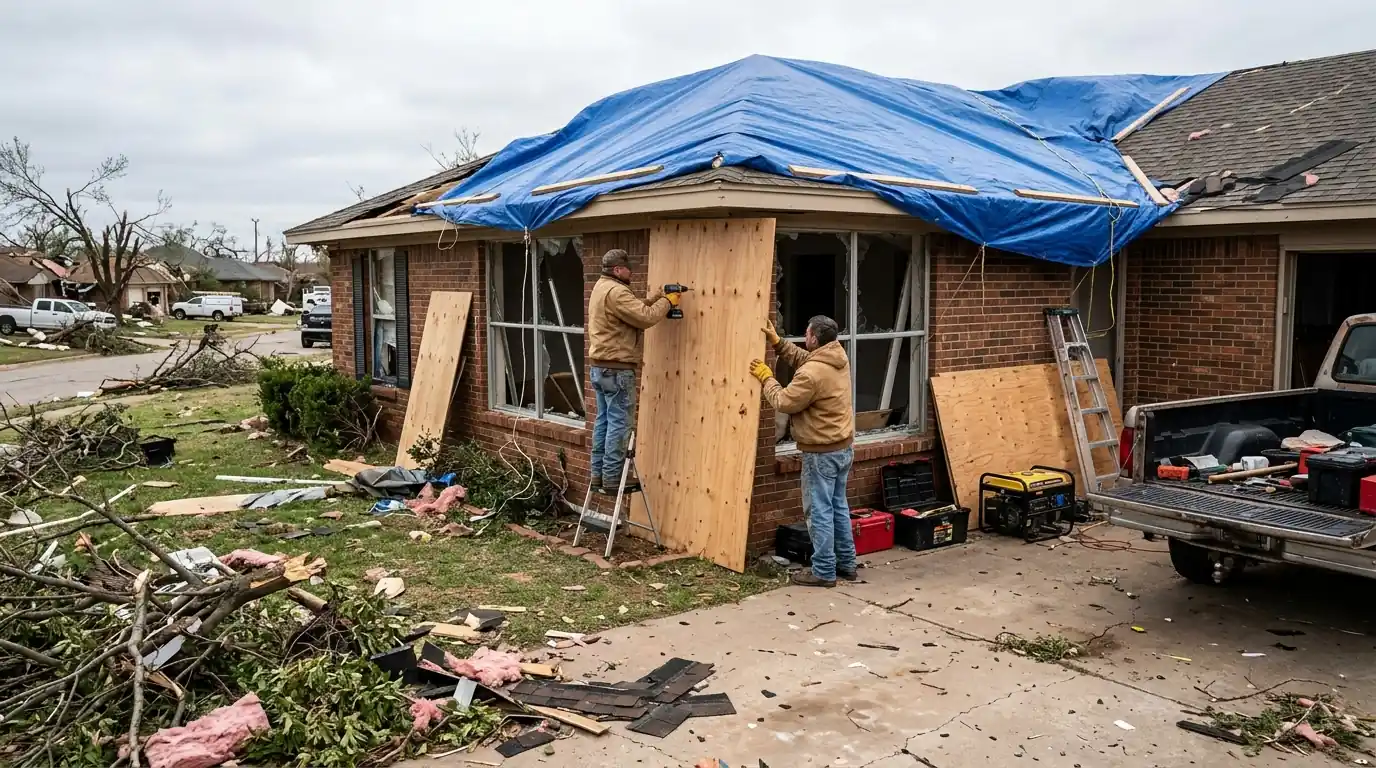
Leave roof work to people with fall protection. Our emergency roof tarping uses heavy tarps fastened through battens into sound decking rather than weighted down with bricks. Broken windows and doors get plywood through emergency board-up, which also secures a house that may sit empty for a while. Where a wall or roof section is badly damaged, temporary shoring holds it until the rebuild.
Angi puts standard roof tarping at $150 to $3,300, with an average of $450, and $1.00 to $2.80 per square foot for rush service. Treat those as national planning ranges, and keep every receipt for temporary repairs.
Photos and records before the cleanup starts
Before anything is moved, walk the whole property with your phone. Start outside with each side of the house from a distance, then close-ups of the roof, siding, windows, fences, vehicles and trees. Inside, film each room, ceilings included. Photograph damaged belongings where they landed. Take one clear shot of the house number so every photo can be tied to the address.
Write a short timeline: when the storm hit, when you got back, what you did first. Save every receipt for tarps, plywood, hotel nights, meals and anything else you buy because of the storm. Do not throw away damaged items until whoever handles your claim has seen them or said photos are enough. Contact your insurance company early and ask what they need from you. If you have a home inventory, older videos or photos of the rooms, pull them out now; they help show what was there before.
Dealing with this right now? Call (405) 689-1123 any hour. A person answers and we get a crew moving.
Trees, debris and what to leave alone
Clearing the yard can wait a day. Limbs tangled in power lines belong to the utility. Trees resting on the roof are under tension and can roll or drop when cut from below. Removing them is work for a crane or a crew used to it, and our tornado damage repair work starts with that removal and the shoring that follows.
Inside, move wet rugs and soaked belongings to a dry room or the garage only if the floor and the ceiling above are sound. Bag broken glass separately. Keep a pile of damaged items, photographed, instead of hauling them straight to the curb. If you cut limbs on the ground yourself, wear eye and ear protection, keep the saw below shoulder height and never cut from a ladder. Wet drywall and carpet start growing mold within days, so the drying should begin as soon as the house is covered.
Water inside the house after the storm
Tornadoes rarely come alone. NWS Norman records that the same May 31, 2013 storms that produced the El Reno tornado caused historic flash flooding in the metro, with at least 100,000 homes and businesses losing power. A house with an opened roof or blown-out windows often takes in rain the same night, and the power to run fans may be gone.
Once the house is covered, the water inside becomes the priority. Ceilings that took rain through the attic, wet insulation, soaked carpet and the bottom of the drywall all need to dry within a day or two or be removed. The EPA advises drying water-damaged areas within 24 to 48 hours to prevent mold growth. Without power that is hard, because drying equipment needs a generator or restored service, so plan for it early.
Keep any room with a sagging ceiling closed off until someone checks it. Wet ceiling drywall loaded with insulation is heavy, and it can come down with no warning.
Choosing who does the repair
After a big tornado, crews from out of state arrive within days and some go door to door. Oklahoma's Roofing Contractor Registration Act requires roofing contractors to register with the Construction Industries Board every year, so ask anyone working on your roof for that registration. Inside Oklahoma City limits, an August 2025 NICB report says big roofing projects need a city permit, which the contractor or the homeowner can obtain; city officials framed the rule as protection against roofing scams.
Get the scope and the price in writing. Read any contract fully before signing, and be cautious about paying the whole amount up front. Ask for a local office address and a phone number that a person answers. A crew that will still answer the phone after the storm season matters more than whoever knocks first.
Where we can take it from here
What people ask after a tornado hits the house
Wait until emergency officials say your area is open and safe. Then check the outside first for sagging roofs, leaning walls, a gas smell and downed lines. If any of those are present, stay out until the structure and the utilities have been checked.
Only if you can work from the ground or a stable ladder at a low edge. Damaged roofs have weak decking, loose debris and sharp metal, and rain makes them slick. A poorly fastened tarp can also tear off in the next storm and let even more water in.
Many can. Houses with roof, window and siding damage and a sound frame are usually repaired. Where walls have shifted on the foundation or the roof structure failed, those sections get rebuilt. A look at the framing answers the question for your house.
Photograph them first, then move what you can to a dry, ventilated space. Hard items usually clean up. Soaked mattresses, upholstered furniture and paper often cannot be saved. Keep damaged items, or clear photos of them, until your claim has been reviewed.
Run it only outdoors, well away from doors, windows and vents, because the exhaust carries carbon monoxide. Never run one in a garage, even with the door open, and never plug it into a house outlet to feed the wiring.