Mold needs moisture and time, and the EPA advises drying water-damaged areas and items within 24 to 48 hours to prevent mold growth. If drywall, carpet pad or wood under cabinets stays damp past that window, mold can start where you cannot see it. Find the moisture, dry it fully, and remove what will not dry.
Why the EPA's 24 to 48 hour window matters
The EPA's brief guide to mold, moisture and your home advises drying water-damaged areas and items within 24 to 48 hours to prevent mold growth. Mold spores are in nearly every house and do nothing on a dry surface. Give them a wet one, especially paper-faced drywall, carpet backing, cardboard or wood, and growth can begin inside that window.
The clock starts when the material gets wet, not when you notice it. A slow drip under a sink or behind a dishwasher may have been wetting the cabinet floor for weeks. In that case the question is not whether mold started, but how far it has spread and what it is growing on. Summer heat and humidity speed growth, and a house closed up with the air conditioning off while the owners are away is the worst case.
Where mold hides after a leak
Visible mold on a painted wall is the easy case. After most water damage, growth starts in places nobody looks:
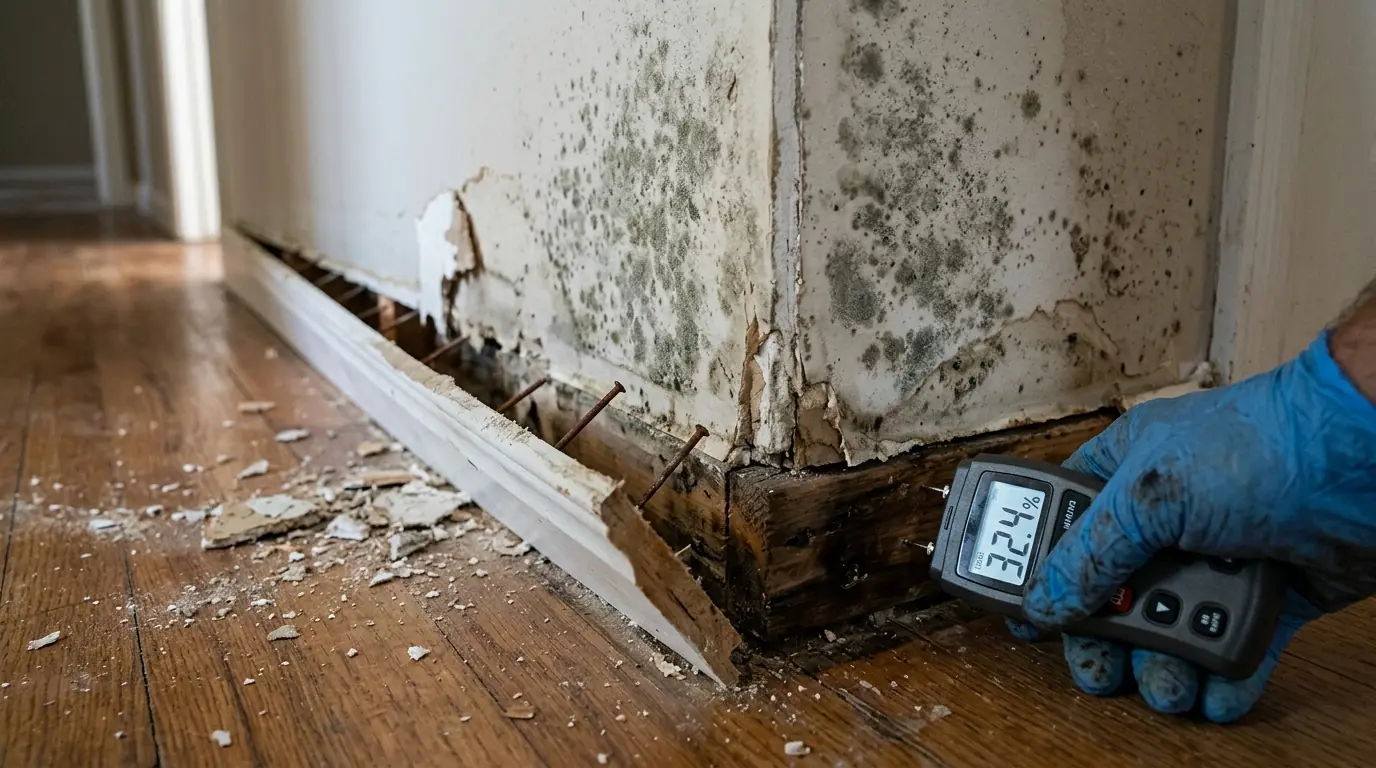
- The back side of drywall behind baseboards, where water wicked up from a wet floor
- Carpet pad and the tack strip around the edges of the room
- Under and behind kitchen and bath cabinets, on the sink base and behind the toe-kick
- Inside wall cavities where a pipe leaked, on studs and insulation
- Under vinyl plank or sheet flooring laid over a wet subfloor or slab
- The attic side of the roof deck after a roof leak, and the crawl space after a plumbing leak
- Inside the air handler and ducts if a condensate line or coil pan overflowed
A musty smell, a stain that returns after cleaning, paint that bubbles, or baseboards pulling away from the wall all point to something behind the surface that stayed wet. Pull a section of baseboard or look in through an access panel before assuming a wall is clean.
Attics and crawl spaces: where mold grows out of sight
Two parts of a house hide mold better than any others. In the attic, a slow roof leak after hail or wind can wet the underside of the deck for months before a ceiling stain appears, and bath fans that vent into the attic instead of outdoors add moisture every time someone showers. The result is dark staining and fuzzy growth on the sheathing, often worst near the vents and the ridge.
Crawl spaces get wet from plumbing leaks, poor drainage and torn vapor barriers. Insulation between the joists holds that moisture against the wood, and mold spreads across joists and subfloor out of sight. Musty air in the rooms above, cupping in wood floors and soft spots underfoot are the usual first clues.
This Old House lists attic mold removal at $1,000-$4,000 as a national range. In both places, removing the growth only lasts if the moisture source, whether a roof leak, a bath fan or a wet crawl space, is corrected at the same time.
Dry it fast, and dry it all the way
Drying the room is not the same as drying the materials. Surfaces feel dry long before the core of the drywall, the bottom plate of the wall or the subfloor is dry. Box fans and an open window help the air, not the wall cavity. Professional drying uses air movers to push air across wet surfaces, dehumidifiers to pull that moisture out of the room, and sometimes small holes at the base of a wall to dry the cavity behind it.
Moisture meters tell you when it is done. Readings in the wet area are compared with a dry reference spot in the same house, and drying ends when they match. Our water damage restoration work takes readings every day for exactly that reason, so nothing gets closed up wet.
Carpet is a special case. Carpet wet with clean water can often be dried in place, but the pad underneath holds water like a sponge and is often replaced. If carpet sat wet for more than two days, or the water was not clean, the carpet and the pad usually both go.
Dealing with this right now? Call (405) 689-1123 any hour. A person answers and we get a crew moving.
The 10 square foot line
EPA guidance draws a practical line by size. If the moldy area is less than about 10 square feet, roughly a patch three feet by three feet, the EPA says homeowners can in most cases handle the cleanup themselves. Growth covering more than 10 square feet calls for the EPA's guidance on professional remediation.
Size is not the only test, and the 10 square foot figure is a rule of thumb rather than a hard limit. Mold that grew after sewage or other contaminated water, mold inside walls or ductwork, and mold in a home where someone has asthma, allergies or a weakened immune system are all reasons to get help even when the visible patch is small.
For a small patch on a hard surface, wear gloves, goggles and an N95 respirator, scrub with detergent and water, and dry the area completely. Porous items like ceiling tiles or carpet with mold growth usually get bagged inside the room, so spores are not shaken loose on the way out, and thrown away. Never mix bleach with ammonia or other cleaners, and do not paint over mold; it keeps growing under the paint.
What remediation involves past that line
Larger mold jobs are about keeping spores from spreading while the moldy material comes out. The work area is closed off with plastic sheeting, the air is filtered and exhausted under negative pressure, and moldy drywall, insulation and carpet are cut out and bagged inside the containment. Framing that stays is cleaned and dried. Then the moisture source gets fixed, because mold removed from a wall that stays wet simply grows back. Expect the rooms inside containment to be off limits during the work, and the HVAC to be shut off or the vents in that area sealed so spores do not travel through the ducts. Clearance is checked before the rebuild begins.
Our mold remediation page walks through that containment. For planning, Fixr puts mold remediation at $1,500 to $9,000, with a national average of $3,500, and This Old House gives $1,200-$3,750 with an average of $2,300. Size, location and access drive any real job.
Testing: when it helps and when it does not
If you can see mold, you usually do not need a test to know it is there. You need it removed and the moisture fixed. Testing earns its cost when there is a musty smell with no visible source, when someone in the house has symptoms and you want to know whether hidden growth exists, or after remediation to confirm the area is clean before the walls are closed. Good sampling includes an outdoor or clean-room comparison, because spores are always present outside and a single number on its own says little.
Fixr lists mold inspection and testing at $450 to $800 when billed separately. Our mold inspection and testing page covers moisture inspection, sampling and clearance checks.
Where we can take it from here
Mold questions after a leak or flood
Bleach can lighten mold on hard, nonporous surfaces, but it does not reach growth inside drywall paper or wood, and the water in it can feed regrowth. On drywall, the fix is cutting out the affected section, drying the cavity and correcting the moisture source.
Color does not tell you the species or the risk, and many molds look dark. The EPA's approach is the same for all of them: fix the moisture, clean up or remove the growth, and protect yourself while doing it. Size and location decide who should handle it.
It helps by pulling moisture out of the air, and keeping indoor humidity down slows mold. On its own it will not dry the inside of a soaked wall, carpet pad or subfloor in time. Those need air moving across them and, sometimes, opening up.
Common clues are a musty smell that is stronger near one wall, paint that bubbles or peels, baseboards or drywall that feel soft, and stains that return after cleaning. A moisture meter and thermal camera find the wet area, and a small inspection opening confirms it.
It comes back when the moisture does. Removal takes out the growth, but spores are always around. If the leak, condensation or poor ventilation that caused it is fixed and the area stays dry, the mold has nothing to grow on.