Document storm damage in this order: stay safe, then photograph and film the outside and inside before anything moves, then keep receipts for every temporary repair. For water inside, a daily moisture log shows what got wet and when it dried, and a line-item scope lists each repair with quantities. Check your own policy for deadlines and requirements.
Why storm records matter so much in Oklahoma
Storm claims are routine here. State Farm's annual hail claims report ranked Oklahoma fifth among states for hail claim payouts in 2025, and a Cotality report cited by The Oklahoman counted 38,737 Oklahoma homes hit by damaging hail that year. The Oklahoman, citing a 2025 Bankrate report, said Oklahoma ranks 47th of 50 states for homeowners insurance rates, and the state insurance commissioner attributes that mainly to extreme weather, high claim frequency and higher repair costs.
None of that tells you what your own policy covers. It does mean adjusters here handle a lot of storm files, and a file with clear, dated, organized records is easier for everyone to review. This guide covers what to collect. It cannot predict how any claim will be decided; your policy and your insurer decide that, and questions about your rights belong with your agent or an attorney.
Safety comes before the camera
Do not climb onto a storm-damaged roof to take pictures. Stay away from downed power lines and anything touching them. Do not walk under a sagging ceiling to photograph it; shoot it from the doorway. If there was a fire, wait until the fire department releases the house. Photos from the ground, from a ladder set at the eaves, and through windows are plenty for a first record, and an inspector can document the roof itself later.
What to photograph, and how
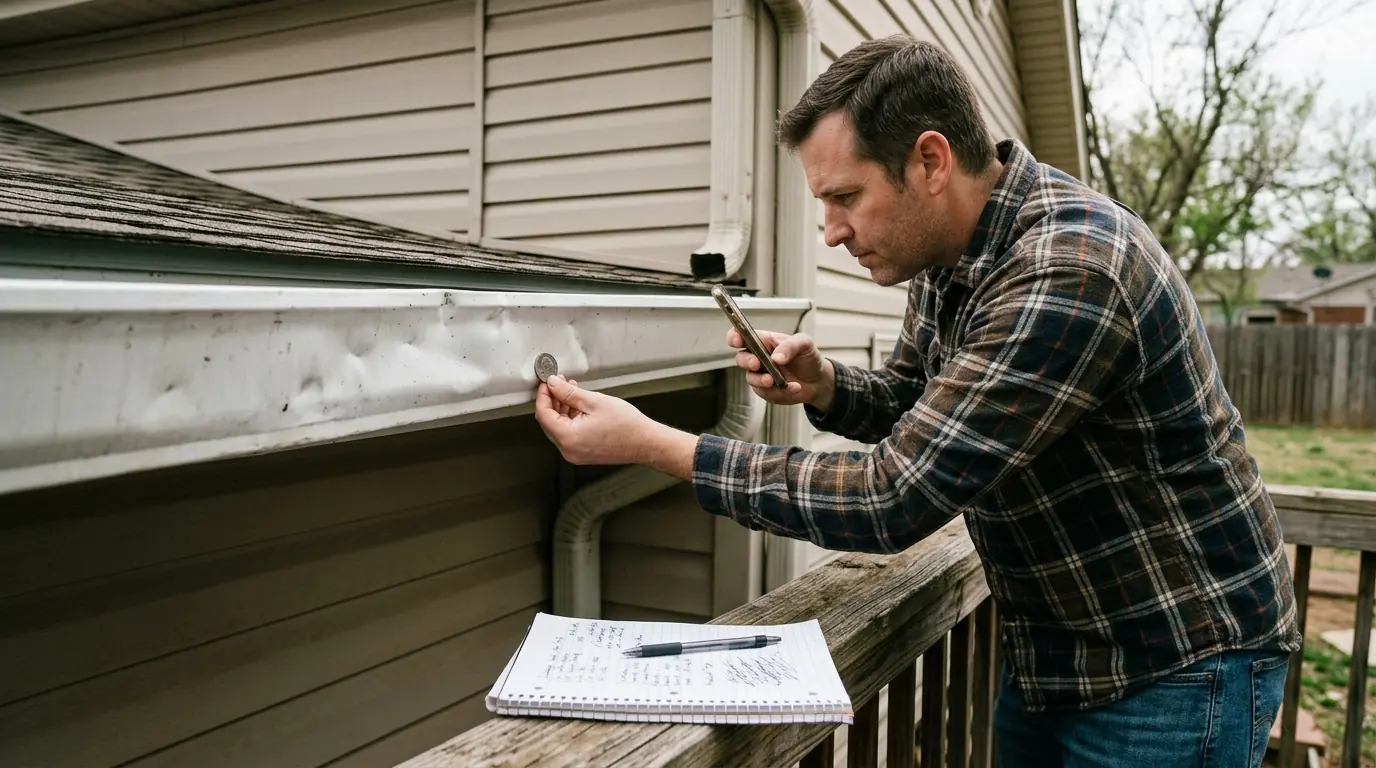
Take more photos than you think you need. For each area, shoot a wide view that shows where it is on the house, then a medium view, then a close-up. Hold a coin, ruler or tape measure in the close-ups so size is clear. Keep your phone's date stamp on.
- Each side of the house from the yard or street, and the roof from every angle you can reach from the ground
- Hail size: a stone next to a coin or ruler, taken as soon as it is safe, before it melts
- Soft metals: dented gutters, downspouts, roof vents, AC fins, the mailbox and the car
- Broken windows, torn screens, cracked or holed siding and damaged fences
- Inside: ceiling stains, wet carpet, damaged walls and anything that got rained on
- Damaged belongings where they sit, with brand and model labels visible where you can
- Trees or limbs on the structure, and exactly where they hit
Video works well for a slow walk through each room while you describe what you see. Back everything up to a cloud folder or email it to yourself the same day, organized by outside, then each room. For the roof, a photo from a second-story window or from across the street often shows more than one from the yard.
Receipts and a running log
Keep receipts for everything you spend because of the storm: tarps, plywood, fasteners, fans, a hotel room, meals while you are out of the house, boarding pets, a rental car. Keep the invoices for emergency work like roof tarping and board-up too. Put them in one envelope, or photograph each one into a single album on your phone.
Start a simple log in a notebook or a phone note. Write the date and time of the storm, when you found each kind of damage, each call with your insurer, the name of the person you spoke with and what they said. Short entries are fine. The point is a timeline you do not have to piece together later.
Do not throw out damaged items, especially carpet, pad or drywall that has to come out, until your insurer has seen them or told you photos are enough. If something must go for safety, photograph it first and keep a small sample, such as a square of carpet with its pad.
Dealing with this right now? Call (405) 689-1123 any hour. A person answers and we get a crew moving.
Putting the file together so it is easy to hand over
A storm file is only useful if you can find things in it. Make one folder, paper or digital, with a few clear parts: photos and video sorted by area, receipts, your running log, contractor estimates and reports, and every letter or email from your insurer. Name the photo folders by location, such as roof front, roof back or kitchen ceiling, so the right image is easy to pull.
Keep the originals. Send copies, and write down what you sent, to whom and when. Once you have a claim number, put it at the top of the log and in every email. If an adjuster visits, note the date and who came, and ask whether their estimate will be shared with you in writing.
Photos from before the storm help a lot when you have them. Real estate listing photos, an old home inspection report, or family photos that happen to show a room or the roof can show condition before the damage. Save copies into the same folder.
What a moisture log is
When storm water gets inside through a roof opening, a broken window or wind-driven rain, the stain you can see is only part of the damage. Water runs inside walls and under flooring. A moisture log records where the water went and how the drying went.
On each visit, readings are taken at the same marked points with a moisture meter and written down with the date, the material and a reference reading from a dry part of the same house. Thermal images show where the wet edges are. The number and placement of air movers and dehumidifiers are noted each day. When every point matches the dry reference, the materials are dry, and the log shows when that happened.
That record answers the questions adjusters commonly ask: what got wet, how far it spread, why a wall was cut, and why equipment stayed as long as it did. Our damage assessment and insurance documentation work produces photo logs, daily moisture logs and a written scope.
What a line-item scope looks like
A line-item scope breaks the repair into individual tasks with quantities and units instead of one lump price. For a hail and wind loss it might list squares of shingles to tear off and replace, linear feet of drip edge and gutter, the number of roof vents and pipe boots, square feet of siding and each damaged screen. For water inside, it lists square feet of drywall and insulation removed and replaced, linear feet of baseboard, square feet of flooring, paint by room, and days of drying equipment.
A scope written this way can be checked against the photos and logs line by line, and you can lay it beside the insurer's estimate to see exactly where the two differ.
Get the house covered while the paperwork moves. Policies commonly ask policyholders to take reasonable steps to prevent further damage, so read that section of yours. Our emergency roof tarping closes roof openings, and hail damage roof repair covers the shingle work that follows.
Where we can take it from here
Storm documentation questions
Ask your insurer and read the duties section of your policy. Most homeowners photograph the damage, then cover roof openings and broken windows right away to keep more water out, keeping receipts and photos of that work. Permanent repairs usually wait until the damage has been reviewed.
For a storm file there is no such thing. Hundreds of photos are normal for a house with roof, siding and interior damage. Organize them by area, outside first and then room by room, and label the folders so you can find a specific shot when someone asks.
Hidden damage often appears later, such as a ceiling stain after the next rain or a wet spot in the attic. Photograph it, note the date you found it, and tell your insurer. Ask how they want the additional damage added to the existing claim.
Hail-size photos help, but they are not the only record. Dents in gutters, vents and AC fins, a neighbor's photos, and the date and time of the storm written in your log all show what fell. Weather service storm reports for that date can support it too.
Yes. With your permission we share the photo log, the daily moisture readings and the line-item scope with your adjuster, directly or through you. How you use them in your claim is up to you and your insurer.