Start on the ground, not on the roof. If hail in your yard reached about 1 inch, the size of a quarter, which the National Weather Service treats as severe, check the gutters, downspouts, window screens, AC unit and car. Dents and splatter marks there usually mean the shingles took hits too, and a roof inspection is worth scheduling.
What size hail starts damaging roofs?
The National Weather Service sizes hail against everyday objects: pea 1/4 inch, penny 3/4 inch, quarter 1 inch, walnut or ping pong ball 1 1/2 inches, golf ball 1 3/4 inches, hen egg 2 inches, tennis ball 2 1/2 inches, baseball 2 3/4 inches, grapefruit 4 inches and softball 4 1/2 inches. NWS treats hail of 1 inch or larger as the severe criteria, and a thunderstorm producing it counts as a severe thunderstorm.
That threshold lines up with what shows on roofs. Pea and penny hail rarely does more than knock loose granules on an asphalt roof in decent shape. At quarter size and up, older and thinner shingles start to bruise and crack, and soft metals dent. Wind matters as well. Hail driven sideways hits siding, screens and the windward slopes harder than straight-down hail of the same size.
If it is safe, measure a hailstone right after the storm or photograph one next to a coin. Stones melt fast, and a size guessed from memory a week later is weak evidence. Hail size can also change a lot from one neighborhood to the next in the same storm, so a report from across town tells you little. What fell in your own yard is the number that matters.
Central Oklahoma has seen the far end of that chart
Hail here is not always quarter size. The Oklahoma Climatological Survey logged 3.75-inch hail at Del City and 4.00-inch hail just east-northeast of Moore on May 10, 2010. Six days later the survey recorded 4.25-inch hail 5 miles northwest of Oklahoma City, 2.50-inch hail at Tinker Air Force Base and 2.00-inch hail at Warr Acres, with roof, tree and car damage from northwest Oklahoma City through Midwest City.
News 9's reporting on the May 16 storm listed Belle Isle, Nichols Hills, Piedmont and the northwest side of Oklahoma City among the places hit, and in Piedmont hail broke windows and pierced home roofs. Statewide, a Cotality report cited by The Oklahoman counted 38,737 Oklahoma homes hit by damaging hail in 2025, third in the nation behind Texas and Wyoming. For most houses here, hail is a repeat repair item over the life of a roof.
Ground-level clues to check before anyone climbs
You can learn a lot from the yard. Painted and soft metal surfaces show hail far more clearly than shingles do, and they sit in the same storm. Walk all four sides of the house and look for these:
- Gutters and downspouts: round dents along the front lip and the elbows, and paint chipped off in spots
- AC condenser: rows of flattened fins on the top or on the side that faced the storm
- Window screens and wraps: small holes or tears in the mesh and dents in aluminum window trim
- Siding and trim: cracked or punched vinyl, chipped paint on wood and fiber cement, fresh splatter marks
- Mailbox, grill lid, fence caps and the car: dents here mean the stones had real weight
- Granules: piles of dark grit at the bottom of the downspouts, well beyond the usual trickle
Note which side of the house shows the most damage. That tells an inspector which slopes to check first. Cracked or holed siding is its own repair; our hail and wind siding repair page covers vinyl, fiber cement and wood.
What a hail hit looks like on an asphalt shingle
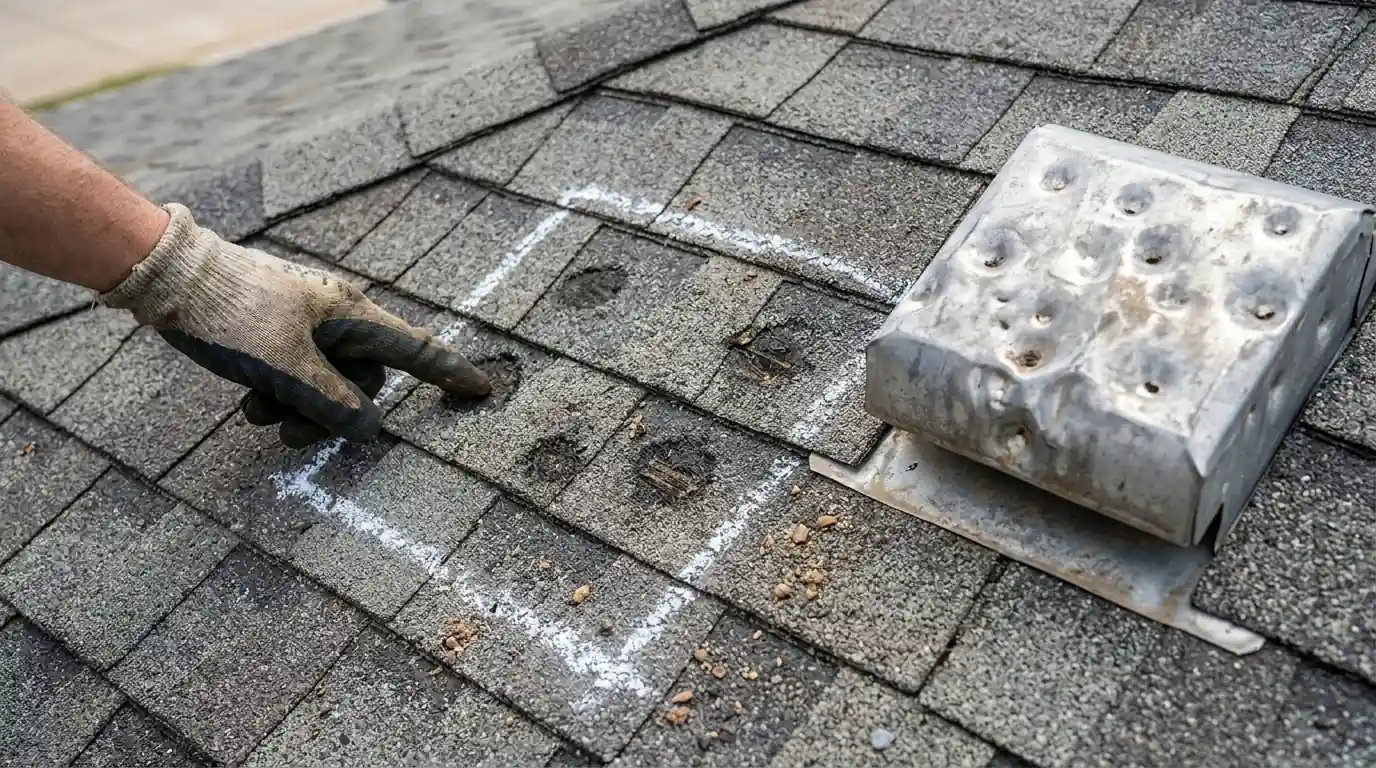
A hail hit on an asphalt shingle usually shows as a dark spot where the granules were knocked off, roughly round, and scattered at random across the slope. Pressed with a gloved finger, a fresh hit can feel soft, like a bruise on an apple, because the mat under the granules is fractured. Larger stones crack shingles outright or snap the corners off tabs.
Randomness is the tell. Wear from age follows patterns: granule loss along the bottom edge of every tab, blistering on the sunny slope, curling at the corners. Foot traffic and old repairs leave their own marks. Telling these apart is the main job of an inspection, which is why a few photos of dark spots are not enough on their own.
Check the metal up top too. Dented roof vents, ridge vents, pipe boots, flashing and chimney caps can often be photographed from a ladder at the eaves, and they confirm the roof itself was struck.
Other roofing shows hail differently. Wood shakes split along the grain with fresh, light-colored edges, metal panels and trim take round dents, and clay or concrete tile cracks or chips. The same randomness test applies to all of them.
Dealing with this right now? Call (405) 689-1123 any hour. A person answers and we get a crew moving.
Check the attic and ceilings in the days after
Some hail damage shows up from the inside first. If you have safe attic access, go up on a dry afternoon with a flashlight and stay on the walkway or the joists. Look at the underside of the roof deck for fresh water stains, damp spots around nails, and daylight around vents and pipe boots. Check the insulation below those spots for wet or matted patches.
Downstairs, look at the ceilings along exterior walls and near bathroom vents and plumbing stacks, where roof penetrations sit above. A new tan ring or a soft spot in the drywall after the first rain that follows a hailstorm is a clear sign water is getting through. Photograph it with the date, and call before the next storm.
Look at skylights from inside as well. Cracked skylight lenses and dented curbs let water in quickly, and they are easy to miss from the yard.
Why you should not walk the roof yourself
A hail-damaged roof is a poor place to stand. Loose granules roll under shoes like ball bearings, wet shingles are slick, and on a steep roof a slip ends at the gutter line or past it. Decking softened by an old leak can be weaker than it looks. Binoculars from the yard, photos from a ladder set at the eaves, or a drone if you own one will tell you plenty.
After a big storm, people knock on doors offering free roof checks. Oklahoma's Roofing Contractor Registration Act requires roofing contractors to register with the Construction Industries Board and renew every year, so ask anyone who wants to climb your roof for their registration. Be cautious with anyone pushing for a signature on the spot.
When to schedule an inspection
Schedule one when you find dented gutters or vents, broken screens, cracked siding or granules piling at the downspouts after a storm with hail near an inch or larger. Call right away if any ceiling shows a new stain or drip, because that roof needs a cover before the next rain.
On an inspection we walk each slope, mark and photograph hits inside a test square, check the soft metals and look in the attic, then write up what we found so you have a record whether or not you file a claim. Our hail damage roof repair page covers the repairs. For a leak already coming in, emergency roof tarping keeps water out until the roof is fixed.
Where we can take it from here
Hail and roof questions from Oklahoma City homeowners
Look from the ground the same day, while hailstones and fresh dents are easy to spot. Have the roof inspected within a few weeks. Hits on shingles weather and blend in over the following months, and small cracks let water in long before anything shows from the yard.
Yes, and most do at first. A bruised shingle keeps shedding water for a while. The fractured mat under the missing granules wears faster in sun and heat, and the leak tends to show up a season or two later, when nobody remembers which storm caused it.
Not always, but they are a strong hint. A car hood is thin painted steel and dents from smaller stones than most shingles will crack from. If the car, gutters and AC fins all show hits, the roof took the same storm and deserves a closer look.
Rarely, on a roof in decent shape. Pea and penny hail, a quarter inch to three quarters of an inch on the National Weather Service chart, may knock loose some granules. Wind-driven small hail on an old, brittle roof is the exception worth checking.
Metal panels dent, and on many roofs those dents are cosmetic while the panel still sheds water. Hail can also crack sealant, loosen fasteners and bend trim and flashing, which can let water in. An inspection on a metal roof looks for openings, not just dents.