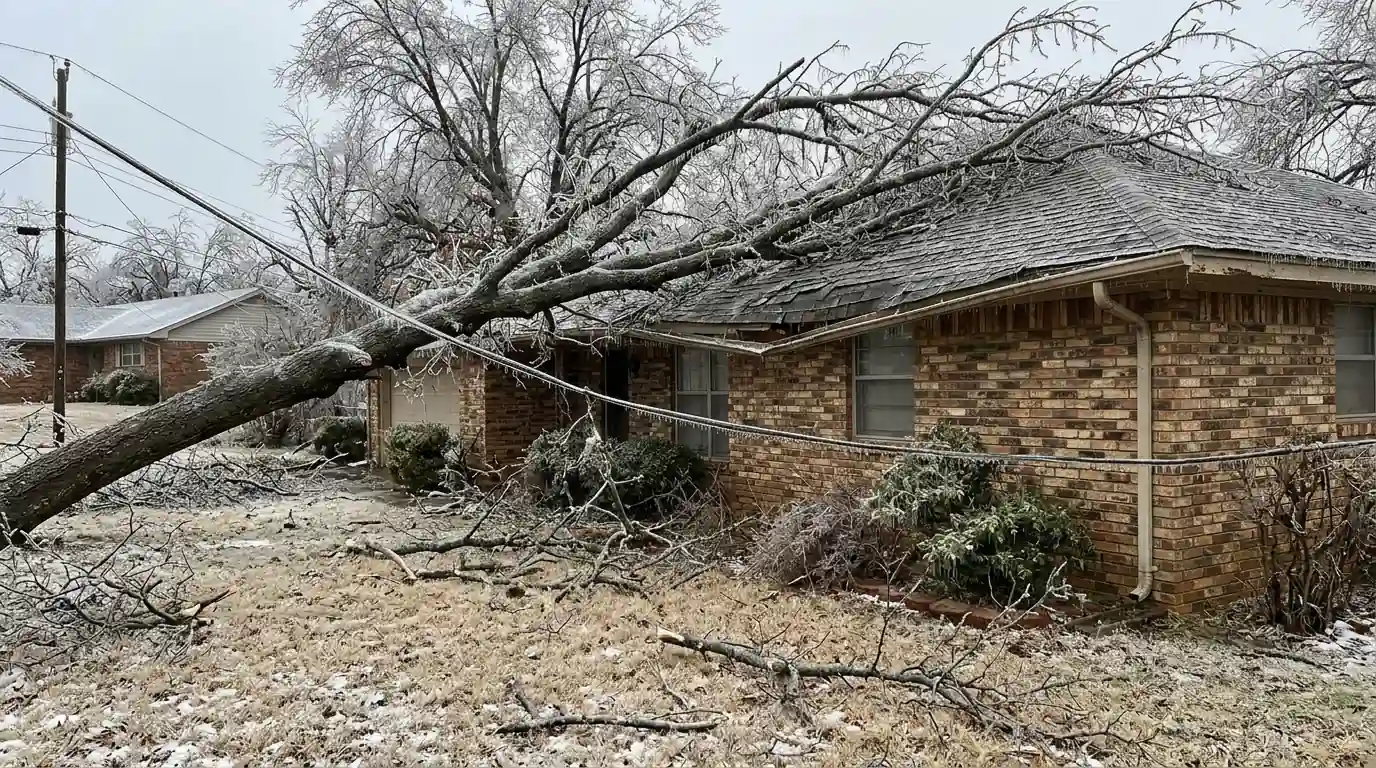
When an ice-loaded limb hits your house, stay away from any power line it touched or brought down, check for a gas smell or smoke, and keep everyone out of rooms with a cracked or sagging ceiling. Report lines to 911 or the utility. Then photograph the damage and get the opening covered, leaving limb removal from the roof to a rigged crew.
What October 2020 showed about ice and trees here
NOAA's Weather Prediction Center review of the October 26-28, 2020 ice storm says it put more than 1 inch of ice on parts of Oklahoma just west of Oklahoma City. Oklahoma emergency management reported that nearly every tree in Oklahoma City had some damage, because many trees still had leaves that collected ice. A tree that would shed ice in January held it like a sail in October, and every coated leaf and twig added weight to limbs already reaching over roofs.
The damage went past the trees. At the peak more than 375,000 Oklahomans were without power, the WPC review says, and more than 40,000 of those outages lasted ten days. NPR reported power lines sagging under ice casings sometimes 2 inches thick, and Oklahoma City Fire responding to numerous house fires, smoke investigations and downed power lines as lines fell onto homes and buildings.
Stay clear of the lines first
Treat every downed or sagging line as live. That includes the service drop from the pole to your house, cable and phone lines tangled with power lines, and anything a line is touching: a limb, a gutter, a chain-link fence, a puddle. Keep everyone, pets included, well back. Report it to 911 or the electric utility. Never try to move a limb off a line with a rake, rope, pole saw or ladder.
Call 911 right away and get everyone out through a door away from the line if you notice any of these:
- Smoke, a burning plastic smell, or sparking at the roof, the meter or the service drop
- A gas smell near the meter or inside the house
- A limb resting on the wires where they attach to the house
- Lights flickering or outlets going dead in part of the house after the impact
If a line falls on your car while you are in it, stay inside unless there is fire, and wait for the utility to tell you it is safe.
Checking the house without standing under the damage
Once lines are not a threat, look from outside. Where did the limb hit, is it still resting on the roof, and is there an opening? Inside, check the rooms under the impact for cracks across the ceiling, new stains, or drywall that sags or bulges. Stay out of any room where the ceiling is sagging and close the door. A ceiling holding water or debris can come down at once.
If you can reach the attic without passing under the damage, look for broken rafters or trusses, daylight through the deck and wet insulation, using a flashlight from the walkway. Do not step off the boards onto ceiling drywall. Photograph what you see from where you stand, then get back down. Outside, look at the chimney and the brick or siding where the limb struck, since masonry can crack and shift behind a mark that looks small.
Water inside after a limb opens the roof
A limb that opens the roof lets ice, sleet and then meltwater straight into the attic. Insulation soaks it up, the ceiling drywall below takes the weight, and water finds light fixtures and the tops of walls. With the power out, nothing is drying it.
Move what you can out of the rooms below the impact, but only if the ceiling is not sagging. Set buckets under steady drips. If a bulge forms, leave the room and close the door, because a bulging ceiling is holding water and can drop at once. Shut off power to that part of the house at the breaker only if you can reach the panel from a dry spot.
Once the roof is covered and the power is back, wet insulation and ceiling drywall have to dry fast or come out. The EPA advises drying water-damaged materials within 24 to 48 hours to prevent mold growth, and a ceiling that sat wet through a long outage usually gets replaced rather than dried.
Dealing with this right now? Call (405) 689-1123 any hour. A person answers and we get a crew moving.
Getting the limb off and the roof covered
A big limb on a roof carries weight and tension that are hard to read, especially with ice still on it. Cut from below, it can swing, roll or drop through the deck. Removal from a roof is done in pieces from the top down, often with rigging or a crane, by people who do it every week. Our tree on house damage repair work handles that removal, then the rafters, the deck and the ceiling below.
Once the limb is off, the opening should be covered as soon as it is safe. Ice storms end in a melt, and every hole in the roof turns into a drain. Emergency roof tarping keeps meltwater out of the attic until the framing and decking are repaired. This Old House notes emergency tree removal can cost up to $5,000, so get the scope in writing before the saws start. Ask the crew how they will protect the roof and the yard during removal, and where the wood is going.
Damage that shows up after the ice melts
Not all ice storm damage is a limb through the roof. Gutters pull away from the fascia under the weight of ice. Smaller branches gouge shingles and dent vents on the way down. A limb that glanced off can crack a rafter without leaving a hole. After the melt, look again from the yard and in the attic for new stains, drips, lifted shingles and sagging gutter runs, and photograph each with the date, because ice storm damage tends to be found in stages. Our storm damage repair page covers ice and wind damage to the rest of the house.
Long outages bring their own risks. NOAA normals put Oklahoma City's typical first fall freeze around November 2, and the October 2020 storm arrived before it, when many houses had not yet been readied for cold. If the heat is out and temperatures drop below freezing, pipes in attics and outside walls are at risk. If you run a generator, keep it outdoors, well away from doors and windows.
Lowering the risk before the next ice storm
Trees that hang over the roof are the ones that hit it. Have a tree service look at large limbs over the house, especially long horizontal limbs, trunks that split into a tight V, and branches with cracks or decay. Removing dead wood takes away the pieces most likely to fail first, and thinning a dense crown spreads the ice load. Young trees planted close to the house become the next generation of roof hazards, so plant large species well away from the roof line.
Never trim near power lines yourself. Branches touching or close to the service drop are a job for the utility or a line-clearance crew. Before winter, clean the gutters so meltwater can drain, and make sure you know where the main water shutoff and the breaker panel are before the power goes out.
Where we can take it from here
Ice storm and fallen limb questions
Report it to the electric utility or 911 and keep everyone back. Nobody should cut or move a limb touching a line until the utility has made it safe. After that, the part on your roof or in your yard can be removed by a tree crew or as part of the repair.
A cracked or hanging limb over the house is a risk with every gust and the next round of ice. Have it looked at soon. If it is resting on the roof or wedged in other branches, removal calls for a crew with rigging, not a pole saw from a ladder.
Leaves give ice more surface to coat. NOAA's review of the October 2020 storm noted that many Oklahoma City trees still had leaves that collected ice, which is why emergency management reported damage to nearly every tree in the city. Bare winter branches carry less.
Possibly. A glancing limb can crack shingles, dent vents, bend gutters or crack a rafter without leaving a hole. Check the attic under the impact for daylight, split wood or new stains, and look from the yard for loose or creased shingles.
If the house will get cold enough to freeze pipes, shut off the main and drain the lines, starting with the lowest faucet. Run any generator outside, away from doors and windows. Never heat the house with a gas oven or a grill.