Repair when hail hit a few areas of a roof that still has years of life left. Replace when most slopes show damage, the roof is near the end of its life, the decking needs work, or a repair would mean badly mismatched shingles. Roof age, the share of damaged slopes and whether to step up to Class 4 shingles drive the decision.
Start with the age of the roof
Age decides more than any other factor. Asphalt shingles grow brittle as they bake in Oklahoma sun and heat. A younger roof with scattered hits can usually be repaired, because the surrounding shingles are still flexible enough to lift and reseal around new ones. An older roof is harder to repair. Old shingles crack when they are lifted, and a patch on a tired roof often just moves the next leak a few feet over.
If you do not know the roof's age, look for the home inspection from when you bought the house, the paperwork from the last roofer or a permit record. Granule loss across every slope, curled or cupped edges and tabs that crack when gently bent all point to an older roof.
Oklahoma roofs also take repeated storms. A roof that already carries patched spots from earlier hail on several slopes reaches the point where another repair is not worth it sooner than one that has never been touched. And a roof clearly near the end of its life when hail hits would need replacing for age soon anyway; the storm mostly sets the timing.
How much of the roof took hits
An inspection counts hail hits inside test squares on each slope. A slope with hits spread across it, rather than a handful, usually needs replacing as a whole. One or two damaged slopes on a roof otherwise in good shape point toward a repair of those slopes.
Roofers and adjusters think in slopes, not individual shingles. When most slopes on a house show damage, replacing the whole roof is cleaner than patching most of it, and it avoids ending up with three different ages of shingle on one house. Wind matters too. Hail that came in on a strong wind can batter the windward slopes and barely touch the others, so one side of a roof may need replacing while the other side is fine. Ridge caps on top often take hits from every direction. Our hail damage roof repair page covers what a repair includes.
Matching: the catch with partial repairs
Shingle colors and styles change over time. Even the same product line weathers differently from a fresh bundle, so a repaired section on a roof that has been up for years can stand out. On a back slope nobody sees, that may not bother you. On the front slope facing the street, it might.
Discontinued shingles are a bigger problem. If the original product is no longer made, a repair uses the closest available match, and some matches are poor. Ask to see a sample held against your roof before work starts, and decide then whether a repair you can see from the driveway is acceptable.
Color is not the only match issue. Shingle sizes and exposure have changed over the years, and a newer shingle may not line up with the courses on an older roof without trimming. Older three-tab shingles can be especially hard to match in both color and cut. If a partial repair is the plan, ask the roofer to set aside a bundle of the new shingles for future patches, so the next repair has a closer match.
Vents, flashing and decking change the math
A roof is more than shingles. Hail dents ridge vents, box vents, pipe boots, flashing and drip edge, and those parts are often replaced as part of a repair. That is a modest job on its own.
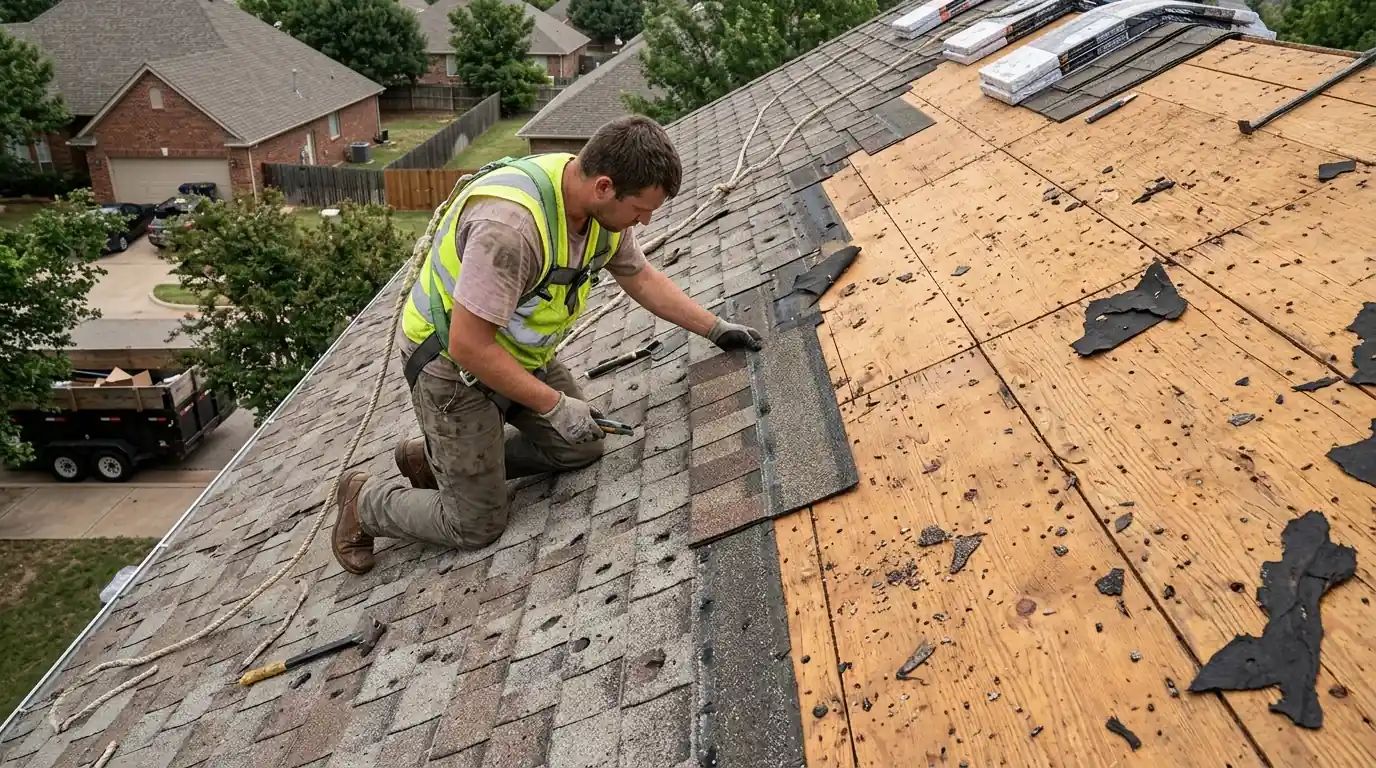
Decking is different. When the plywood or plank deck under the shingles is cracked, soft from old leaks or punched through, it can only be repaired with the shingles off. Widespread deck damage pushes the decision toward replacement, because the roof has to come off anyway to fix what is underneath. On older houses, decking made of spaced boards rather than plywood may need new sheathing before modern shingles go on.
Ventilation is worth checking while the roof is open. Replacing hail-damaged box vents is a chance to confirm the attic has enough intake and exhaust, because a hot, poorly vented attic shortens shingle life.
Dealing with this right now? Call (405) 689-1123 any hour. A person answers and we get a crew moving.
Class 4 impact-resistant shingles
Impact-resistant shingles are tested by dropping steel balls of increasing size onto them, and Class 4 is the top rating in that test. They use tougher mats or rubber-modified asphalt so they resist cracking from hail better than standard architectural shingles. They do not make a roof hail-proof, and very large stones can still damage them. They also need correct installation to hold up: the right nailing pattern, starter strips at the eaves and rakes, and sealed hip and ridge caps. A tough shingle nailed wrong blows off as easily as any other.
This is a metro where the Oklahoma Climatological Survey logged 3.75-inch hail at Del City and 4.00-inch hail near Moore on May 10, 2010, so Class 4 is worth pricing whenever a roof is being replaced. Ask your insurer whether it treats impact-resistant roofs differently on your policy. Our roof replacement after storm damage page covers both architectural and Class 4 options.
What the published numbers say
This Old House puts the average roof repair cost due to hail at $940, or $4-$7 per square foot. HomeAdvisor gives a normal range of $2,632 - $22,127 for storm and hail roof repairs, with post-storm and hail repairs averaging $12,300, a figure pulled up by larger storm jobs. For full replacement, HomeAdvisor lists a normal range of $5,903 - $13,377, an average of $9,609, or $4 and $11 per square foot.
These are national planning ranges, not quotes. The size and pitch of your roof, the number of layers to tear off and the condition of the decking set the real number. Ask any roofer to show how their price breaks down: tear-off, decking allowance per sheet, underlayment, shingles, ridge and hip, vents, flashing and drip edge, and disposal. That turns two very different totals into lines you can compare.
Permits, registration and the written scope
Inside Oklahoma City limits, an August 2025 NICB report says homeowners planning a big roofing project need a city permit, which either the contractor or the homeowner can obtain; city and roofing association officials framed it as protection against roofing scams. Oklahoma's Roofing Contractor Registration Act requires roofing contractors to register with the Construction Industries Board and renew every year. Ask who is pulling the permit and for the registration before work starts.
If a claim is involved, the insurer's estimate may say repair while a roofer says replace, or the reverse. Photos, test-square counts and a line-item scope let both sides look at the same facts and see exactly where they differ. Afterward, keep the final invoice, the permit and the product names in your house file. When you sell the house or the next storm comes, that record shows the roof's age and what was installed.
Where we can take it from here
Repair versus replacement questions
Sometimes. When one or two slopes took the hits and a close match is available, replacing those slopes is a common middle path. It suits younger roofs. On older roofs the new slopes can look different, and the old ones keep aging toward replacement.
Laying new shingles over hail-damaged ones leaves an uneven base, hides deck damage and adds weight to the framing. Tearing off lets the deck be checked and repaired first, which is why a hail replacement is normally done as a full tear-off.
Most look like standard architectural shingles, with similar colors and dimensional profiles. The difference is in the mat and the asphalt. You usually cannot tell them apart from the street, so check the product name on the estimate to confirm what you are getting.
It depends on why the granules are gone. Loss in random spots from hail is damage, while even loss along every tab edge is usually age. Granules shield the asphalt from sun, so bare spots wear faster. An inspection that tells the two apart answers it.
If hail damaged them too, usually yes. Hail that hit the roof often dented gutters and cracked siding as well. Handling those repairs alongside the roof avoids a second round of ladders, dumpsters and disruption a few weeks later.